

Last Updated on July 1, 2022 by Renee’
Okra has so many health benefits from controlling blood sugar, reducing cholesterol, preventing constipation, preventing & controlling asthma, reduces sore throats to boosting the immune system & many more. It is packed full of Vitamin A & carotenes that help with vision, Vitamin C and minerals such as magnesium, calcium manganese & iron. Read more about Magnesium deficiency here.
So as you see, we all need to eat more Okra! And what better way than to eat it fermented so that you get all those glorious gut-healthy probiotics too!
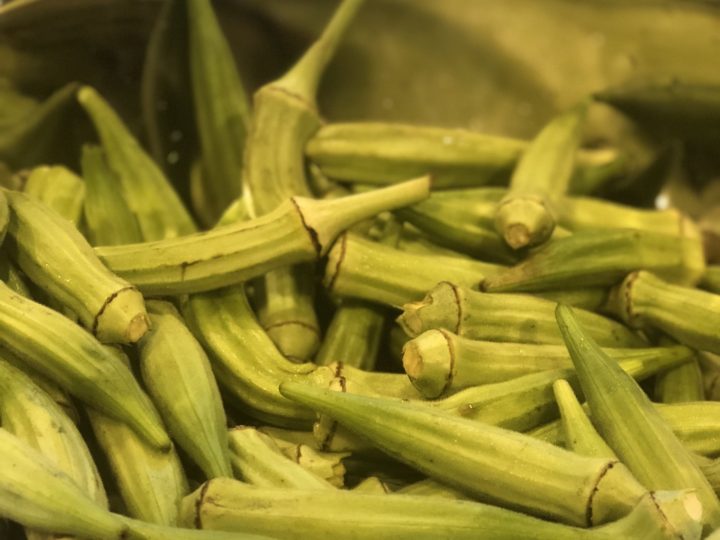
If you have been following me, you know about my dad’s huge organic garden. This year we were blessed to have tons of Okra. Okra has so many health benefits that I wanted to preserve it as many ways as I could. I froze it, canned it & fermented it. It is so simple to make & you can make a small jar or multiple jars at a time!
Ingredients:
- Organic okra, enough to pack in jar of choice (I use pints, & quarts, depending on how much okra I have)
Optional Ingredients:
- garlic cloves
- black peppercorns (leave out for AIP)
- mustard seeds (leave out for AIP)
- red pepper flakes (leave out for AIP)
- coriander seed (leave out for AIP)
- dill (fresh if you have it)
Brine:
- 1-3 Tbs. sea salt (I used 2)
- 4 cups filtered water (Ratio of salt to water is 1-3 Tbs. to 4 cups of water)
Tools:

Directions:
- Mix salt with hot water to dissolve. Let cool.
- Wash, but don’t scrub okra
- Trim the stem end but leave intact (if you cut it too short they will be slimy)
- Put any seasonings &/or probiotics that you wish to in jar(s). I added 2-3 garlic cloves per jar, a few black peppercorns, some coriander & about 1 tsp of dried dill (I didn’t have fresh).
- Pack okra into jar(s) leaving about 1 inch from the top of the jar. (I tilt my jar & place the okra standing up.
- Pour brine over okra enough to cover the top of okra leaving at least 1 in of headspace. Make sure okra is fully submerged. (can use a weight if you like) I didn’t. If you pack the okra thick enough it will not rise.
- Close lid & store in a dark cool room for at least a week to 10 days or longer if you prefer. I left mine a couple of weeks. Just do the taste test, when it gets to the taste that you want, it’s ready!
*Scroll down for the Printable Recipe Card.
Optional:
- optional: 1-2 probiotic capsules depending on how large your jar is. (Makes it ferment faster. I didn’t use it & they turned out great!)
Tips:
- Put a plate underneath the jar just in case they overflow during the fermentation process & burp jars every day after the 1st day or two. You will know when it starts bubbling.
- Make sure to burp the jars every day after it starts fermenting. Usually around 2-3 days.
Filtered Water:
Tap water contains chlorine, which can inhibit fermentation. Use spring or distilled water instead. I am on well water so I don’t have to worry about chlorine or fluoride but I do worry about runoff water so I have a Berkey Filter. The Berkey water filter systems are actually water purifiers because they remove bacteria and viruses also that conventional filters can not. Not to mention heavy metals, pharmaceuticals etc… Read more about it here.
I highly recommend it! I even take it when I travel.

Salt:
Salt with iodine or anti-caking agents can inhibit fermentation. Make sure not to use salt with iodine. I use natural sea salt.
More Easy Fermented Recipes:
- Homemade Sauerkraut
- Cauliflower Pickles
- Fermented Pickled Red Onions
- Honey Fermented Red Onions
- Fermented Cherry Tomatoes
- Fermented Dilly Green Beans
- Fermented Pickled Celery
More Okra Recipes:
Share On Pinterest

Fermented Pickled Okra

Ingredients
- Organic Okra (enough to fill whatever size jar(s) you have)
- seasonings optional - garlic cloves, black peppercorns, mustard seeds, red pepper flakes, coriander seed, dill, etc...
Brine
- 1-3 Tbs. sea salt (I used 2)
- 4 c. Filtered Water
Instructions
- Mix salt with hot water to dissolve. Let cool.
- Wash, but don't scrub okra
- Trim stem end but leave intact (if you cut too short they will be slimy)
- Put any seasonings &/or probiotics that you wish to in jar(s). I added 2-3 garlic cloves per jar, a few black peppercorns, some coriander & about 1 tsp of dried dill (I didn't have fresh).
- Pack okra into jar(s) leaving about 1 inch from the top of the jar. (I hold my jar on it's side & place the okra standing up.
- Pour brine over okra enough to cover the top of okra leaving at least 1 in of headspace. Make sure okra is fully submerged. (can use a weight if you like) I didn't. If you pack the okra tight enough it will not rise.
- Close lid & store in a dark cool room for at least a week to 10 days or longer if you prefer. I started taste testing after about 7-10 days until it suited my tastes. You could leave 3-4 weeks. I couldn't wait that long!
Notes
Make sure to burp the jars every day after it starts fermenting. Usually around 2-3 days.
Recommended Products
As an Amazon Associate and member of other affiliate programs, I earn from qualifying purchases.
-
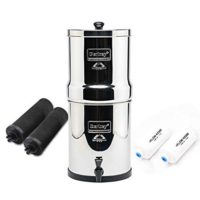 Travel Berkey Water Filter with 2 Black Berkey Filters and 2 PF2 Fluoride Filters
 -
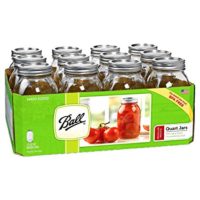 Ball Regular Mouth Quart 12 Pieces Jars (32oz) Made in USA, Clear
 -
 Redmond Real Salt - Ancient Fine Sea Salt, Unrefined Mineral Salt, 16 Ounce Pouch (1 Pack)
 -
 Bormioli Rocco Fido Square Jar's With Blue Lid, 67-3/4-ounce (set of 2)
LOVE THIS RECIPE! I am just now discovering fermenting, I found local okra last week at the “green grocer” and my first batch turned out PERFECTLY! Thank you! I added a grape leaf and my okra are really crisp. I only added some garlic, I wanted to see what the plain flavor was like before trying to add anything else. I will start my second batch tomorrow. I have just fermented kimchi for the first time, also turned out, and I have to admit, I am none too precise, still, I got it right and I am so sold on fermenting! Love the way these fermented vegies taste and how they effect my gut! Thanks again!
That is awesome Christy! Thanks for sharing!
Followed the recipe, used a weighted lid to hold everything down. Brine turned cloudy on day 2 and there was some “slime” substance on top of the weighted lid. Wondering if the slime and cloudy color is due to cutting stems too close. Should this still be safe to try?
I’m not sure without seeing it, but from my experience, fermented veggies are more cloudy than traditional pickled veggies. That would not concern me. The slime is more than likely from the okra being okra & probably being trimmed too close. Give it a week or so & see how it’s doing. Sounds like it’s fermenting just fine.
Fermenting foods is not about experimenting and playing around. I simply landed here to find optional ingredients to add to a jar of Okra I’m going to ferment.
Rule 1, don’t EVER expose your ferments to oxygen. Lacto Bacteria are anaerobic (thrives in oxygen free environments) and must be below the water line. Don’t cover with coffee filters as if anything say a garlic clove was to float up to the production of CO2 during fermentation it would be exposed to oxygen and can grow Botulism, a very deadly aerobic bacteria (thrives in oxygen rich environments).
Rule 2, ferments should always have a ph below 4.7, 4.6 is safe but lower is better. These are acidified foods and as such if the ph is too high you risk getting sick or dying.
Rule 3, don’t blindly say using X cups of water with X grams/tbsp of salt. Also never used Iodized salts. Use sea salts that are finely ground. Here is how you calculate your salt. You weigh EVERYTHING, take your jar and tare your scale. Then add in your optional ingredients, e.g. garlic, at the bottom of the jar, then add your veggies, then fill with water so that the water covers. Take that weight, say 1775 grams, then choose what salinity you want. Say 2.5%. So you multiple the weight of water and all ingredients by 2.5%. In my example 1775 X 0.025 = 45 grams. Now add 45 grams of salt (not need to heat it up to dissolve if you are using finely ground sea salts. Add a weight on top. Then add a special fermenting lid called an airlock. There are multiple styles but they all serve to keep out oxygen. I like to shake mine after this point, but NEVER shake again.
Rule 4, don’t water can Lacto ferments as all you are doing is killing all the good guys that you want to colonize in your belly.
Rule 5, please don’t add aftermarket spice blends unless you know 100% they are additive free as this can impact the fermentation and lead to inedible or dangerous ph levels.
Be safe guys, this isn’t making apple pie. It is 100% chemistry.
How long do you leave it in dark space to ferment before putting it in fridge
Hi Laura, I like to leave mine a couple of weeks or so, but I would start tasting after 10 days. Once it gets to the taste you like then put in the fridge.
I had leftover brine and put it in the refrigerator overnight . Can I add that to my sauerkraut I fermented a month ago in the fridge?
How can I use one day old salt water brine from that fermented okra recipe?
I’m new at this.
Thanks, Amber
Any veggie’s that you have even if it’s just a pint jar you can pretty much ferment. I do carrots, celery, cauliflower, green beans, bell peppers, onions, or a combo of mixed veggie’s.
I had brine leftover in the saucepan so I put it in the refrigerator overnight.
Can I add that to my already fermented cabbage that’s in the refrigerator that I’m made last month ? I want my sourkraut to have more liquid?or how can I use it?
I’m new to fermenting veggies
Thank you
I have not tried this, but I don’t see why you couldn’t add more brine.
Can I use Mrs Wages Dill Pickle seasoning to do pickled Okra?
Great question. I am not sure about that. I’ve never used Mrs. Wages before. Especially in fermented foods. You could always try it, but personally I like to add my own ingredients to taste. Let me know if you try it.
Can these be water bath canned for shelve storage? Yes I know canning will deteriorate the probiotics. Looking for alternatives to pickling or dehydrating.
Probably, but I’ve had some fermented okra in the fridge for 2-3 years & still just as good as they were when I put them in there. I’ve never waterbathed. I think it would make them soggy. If you try it, let me know. Thanks!
Could you use a coffee filter with rubber band instead of lid?
I’ve never done it this way, but I don’t know why you couldn’t. I’ve seen people use this method on other ferments. Let me know how it works. I think this method would eliminate the “burping”.
Great recipe! I will note that I used tap water and iodized salt because that’s what was available. I got bubbles the very next day! So hard to wait a week to eat 🙂
I know what you mean! So hard to wait! Hope you enjoy!
I really wish you told how much of the mustards seeds and other ingredients instead of saying to put some in there. I’m a first time fermenter and kind of freaked out not knowing how much.
I’m sorry, it is definitely by taste. I probably put about a 1/2 tsp. per pint. Not an exact science. You don’t have to add anything other than the salt water brine. Adding other ingredients are just for more flavor. Hope this helps. Sorry for the confusion.
Will pickle juice help with leg carps?
I have heard that Athletes would drink pickle juice for the electrolytes back in the day for cramping. Worth a try I guess. Personally, I would try taking Magnesium. You may have a magnesium deficiency. Read about magnesium deficiency here. https://www.thehealthnutmama.com/magnesium-deficiency/
So I cut an okra stem too short and now my ferment is slimy. It is still safe to eat, right? This is my first time fermenting and I used your recipe. Still unsure about the whole fermenting thing but I am giving it a shot. Thanks for the recipes!
Hi Angela, Yes it should be safe to eat. I’ve done the same thing when I did my first batch! You have to try cauliflower. Another one of my favorites!
Just made these Saturday. My liquid is looking cloudy. Is that normal? This is my first time fermenting anything. Thanks
It will change color. Post a picture or send me one. It should be fine.
What does AIP mean?
Hi Jess! Great question. AIP is for the AutoImmune Paleo Diet. It helps to heal leaky gut & auto-immune diseases. I have put 3 auto-immune diseases into remission with this diet.
So this could be made without spices? will it still be good? lol
Yes, Absolutely!!
How long and how do you store fermented okra?
Hi Leslie, I ferment it at least a couple of weeks. After about 10 days or so, I start tasting it. It should have a pickle taste when ready. I store it in the fridge. It won’t hurt to leave longer if needed.